|
"Article The First Reads As Follows:""After the first enumeration required by the first article of the Constitution, there shall be one Representative for every thirty thousand, until the number shall amount to one hundred, after which the proportion shall be so regulated by Congress, that there shall be not less than one hundred Representatives, nor less than one Representative for every forty thousand persons, until the number of Representatives shall amount to two hundred; after which the proportion shall be so regulated by Congress, that there shall not be less than two hundred Representatives, nor more than one Representative for every fifty thousand persons." |
|---|
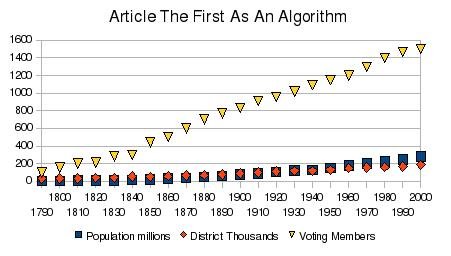
In the illustration above Article The First is interpreted as an algorithm increasing the size of electoral districts by ten thousand each time the nation's populatioin pushes the size of the house past the next 100 member plateau. i.e. when House size exceedes 100 members we increase the district size to 40,000 and then to 50,000 at 200. Hence, 300, 400, 500 members will insist on districts of 60,000, 70,000, and 80,000. As you can see, this would set the current size of electoral districts to between 180,000 and 190,000 with a House membership of 1500.
Article The First was the first proposed amendment to the Constitution as requested by the ratifying conventions. The amendment was to insure adequate representation for the people as the population grew. But it was sabotaged in a joint Senate House committee by replacing the word "less" with the word "more" (as emphasised above) before it went to the states for ratification. As such it was never ratified. The current sabotaged version of the amendment if not interpreted as an algorithm would have no effect on the size of electoral districts or the size of the House. The size of the House is in excess of 200 and the number of representatives is not "more" then one for every fifty thousand. However, the algorithm suggested by the amendment is a possible guideline to be observed in rationalizing the proper size of electoral districts in respect of increasing population.