 |
The Senate Version of Article The First"After the first enumeration, required by the first article of the Constitution, there shall be one Representative for every thirty thousand, until the number shall amount to one hundred, to which number one representative shall be added for every subsequent increase of forty thousand, until representatives shall amount to two hundred, to which one representative shall be added for every subsequent increase of sixty thousand."
|
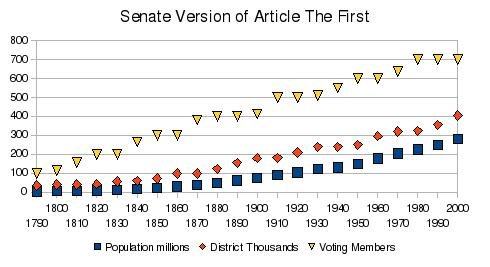
The Chart above is our interpretation of the algorithm buried in the Senate Version. The increase in district size from 100 to 200 seats as set at ten thousand (30 to 40 thousand). At each new increment of 100 seats over 200 the electoral district size will be increased by double the previous increase. i.e. at 300 the ratio went from forty to sixty thousand (an increase of 20,000), at 400 the ratio would go from sixty to 100 thousand (from 60 to 100 is an increase of 40 thousand which is twice the previous 20 thousand increase) and at 500 members the district size is increased to 180 thousand (as 80 is twice 40). Based on the 2000 census the electoral districts would be about 405,000 and the House would have 700 members.
Notice the "lumpy" nature of the rise in House size and in district size. While there may be some advantage to holding at a particular level for several decades and then increasing all at once that does not actually fulfill the obligation to reapportion every ten years "according to their number". It would probably be better to do this with a smooth exponential function that mimics the general trend of increase shown in the chart (see cube root). Most of us are incapable of divining such a function but there are a great many who can, who are trustworthy, and who could agree on a precise definition of such a function. And for some, it is the need to come a lot closer to "one man one vote" that drives the enlargement of the House. Our own goal is smaller, more representative, districts in which the representatives must be more responsive to those being represented. But these two goals are complementary.